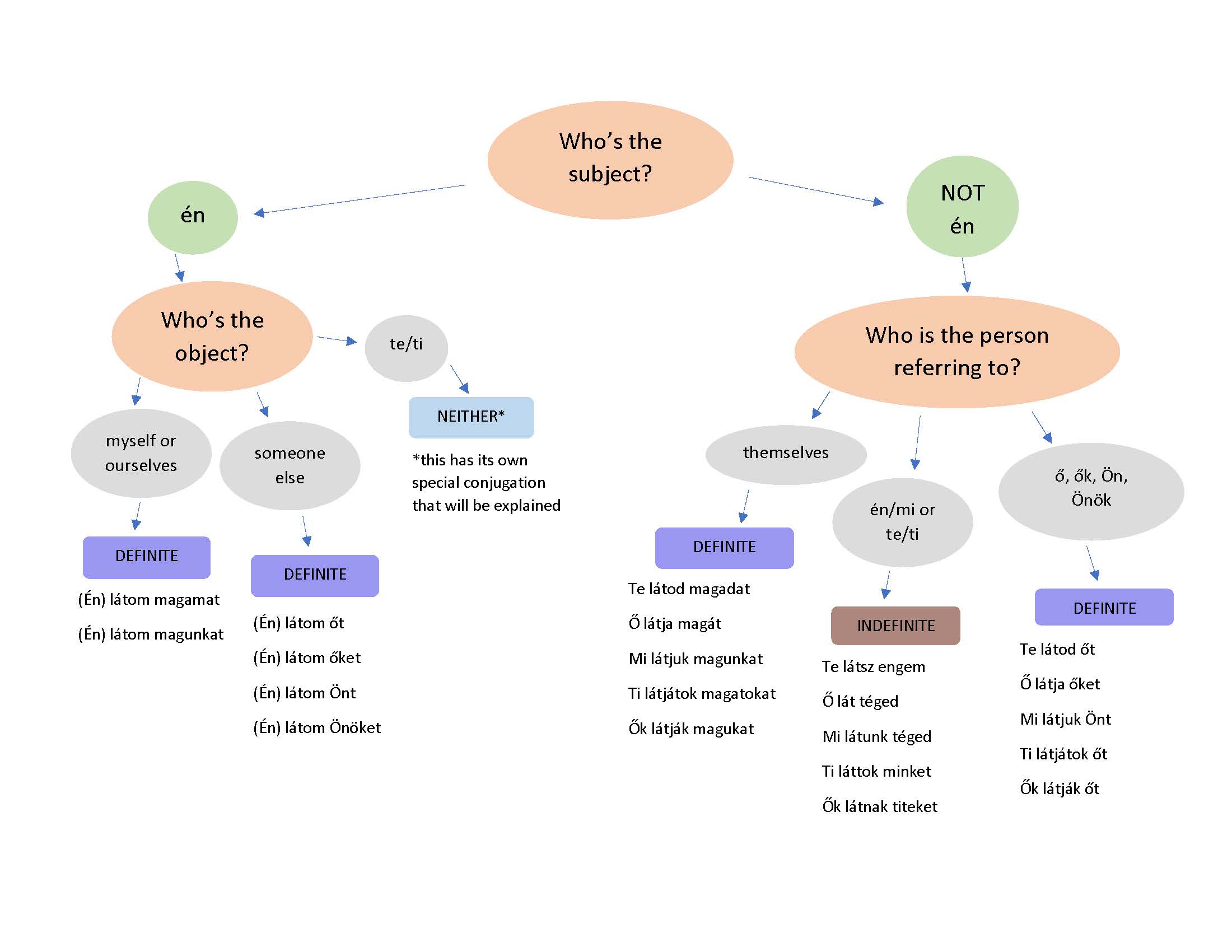
My friend made a handy chart to reference when you should use definite or indefinite conjugation when it comes to pronouns. I tried to tweak it and make it as simple and comprehensive as possible, but don’t hesitate to message if you have any questions!
A kind reader pointed out that the text on this chart may be a bit too small to see properly without opening the image in a new tab, so here is a link that will give you a full size version that will hopefully be much easier to read: HERE
Alternatively, you can right click on the image and select “open image in new tab”. If it is still too small, clicking the image once should zoom in to the full size.
![[Hungarian] -(a)lak/-(e)lek: ‘én + téged’ Conjugation – Better Hungarian Avatar](https://betterhungarian.com/wp-content/uploads/2019/02/cropped-1.jpg?w=40)
 Better Hungarian
Leave a comment