I’m putting these three in the same post, because they are all cases of movement involving places. Specifically, going into places, being in places, and coming out of places.
Illative (-ba/-be)
- back-vowel word: -ba
- front-vowel word: -be
The first thing to know about this one is that it means something is moving. There is a destination at the end, and you are going there (but aren’t there yet).
Use -ba/-be when:
- you are on your way to a place (exception is Hungarian cities, they take -ra/-re)
- something/someone is moving into something else (a place)
Examples
Megyek a hotelbe → I am going to the hotel.
A szekrénybe tettem a ruhát → I put the dress in(to) the wardrobe.
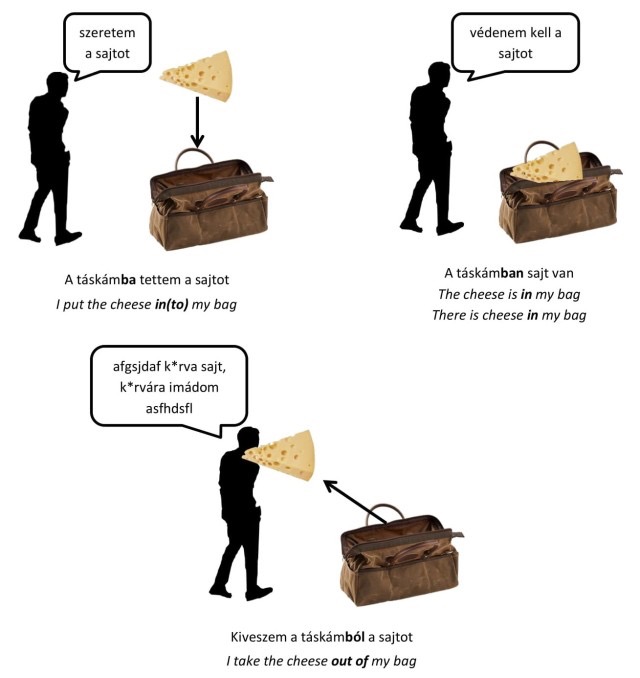
A táskámba tettem a könyvet → I put the book in(to) my bag.
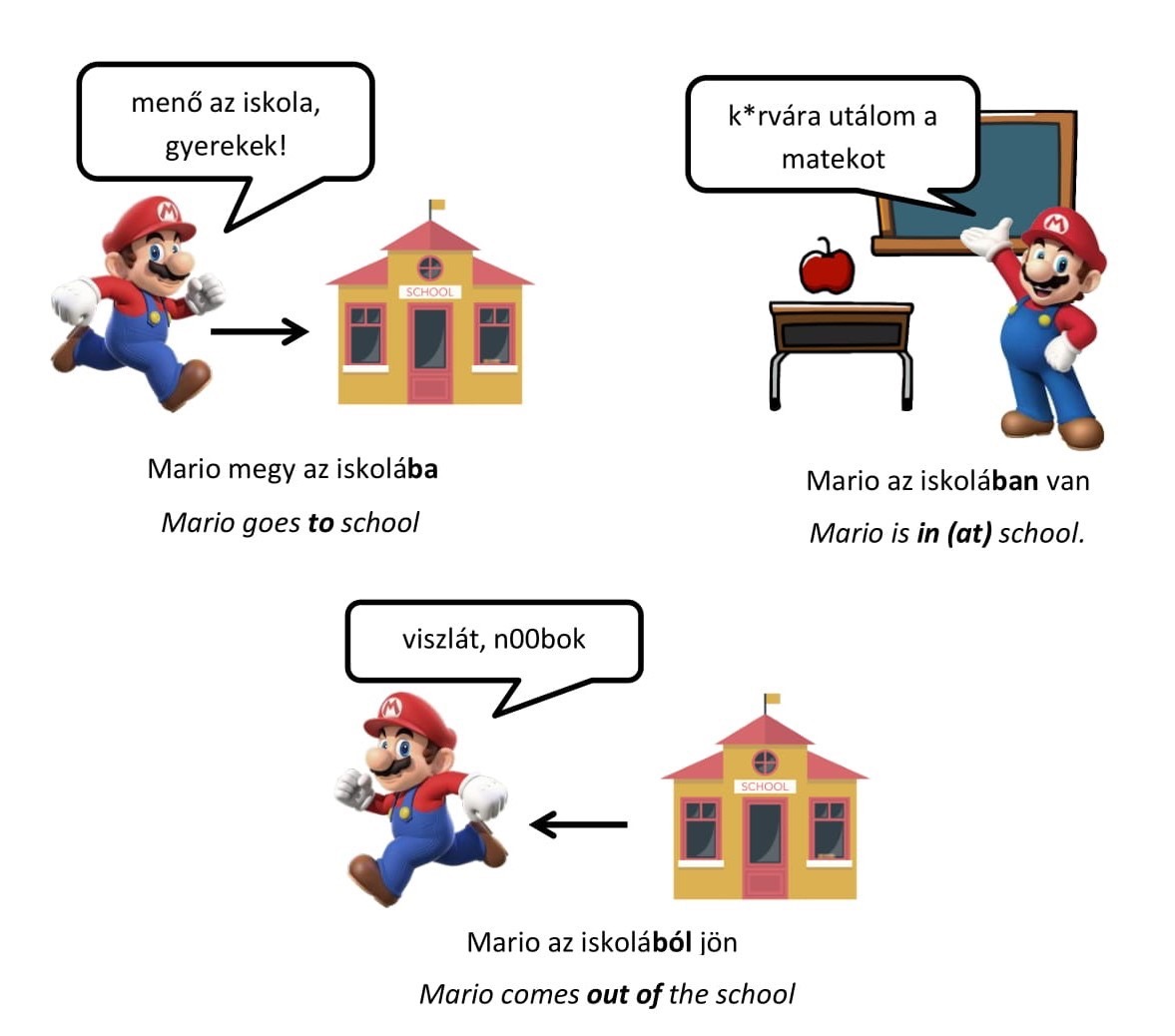
Iskolába megyünk → We are going to school.
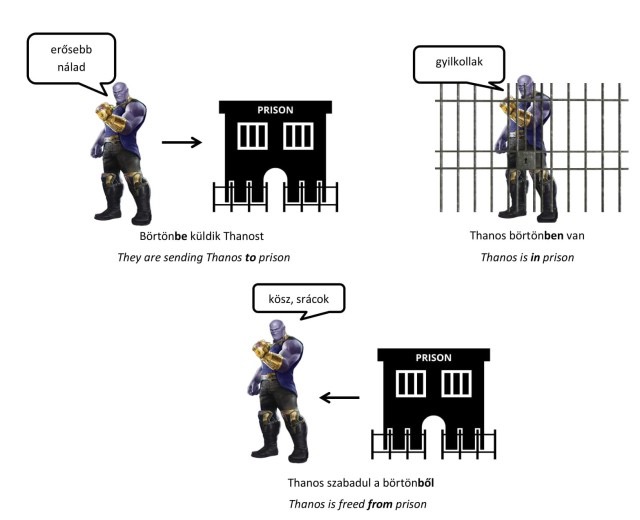
Börtönbe küldenek engem → They are sending me (in)to prison.
Note that the object receiving the direct action (being put, placed, etc) will take the accusative.
Inessive (-ban/-ben)
- back-vowel word: -ban
- front-vowel word: -ben
This is essentially the static version of -ba/-be. Nothing is moving, instead something is currently in a place.
Use -ban/-ben when:
- you are INSIDE the place where you were going (except Hungarian cities, which take -n/-on/-en/-ön)
- something/someone is INSIDE of something else
Examples
Hotelben vagyok → I am in the hotel.
A ruha a szekrényben van → The dress is in(side) the wardrobe.
A könyv a táskámban van → The book is in(side) my bag.
Iskolában vagyunk → We are in(side) the school. (used to say someone is “at school”)
Börtönben vagyok → I am in(side) prison.
Notice the difference? No one is moving or doing anything, -ban/-ben merely indicates a current position of being inside something (a place or a space, typically). Note that the direct object with -ba/-be is now the subject in -ban/-ben sentences, and therefore is in the nominative case, and not the accusative.
Interesting note: When saying you are “at a party”, you would actually say “IN a party” in Hungarian (buliban).
Elative (-ból/-ből)
- back-vowel word: -ból
- front-vowel word: -ből
Think of this as the reverse of -ba/-be. Instead of going INTO or putting something INTO something, you are going OUT OF something, or taking something OUT OF something else.
Use -ból/-ből when:
- you are leaving a place/coming out of a space (except Hungarian cities, which will take -ról/-ről)
- you are taking something out of something else
Examples
A hotelből jövök → I am coming out of the hotel.
Kivettem a ruhát a szekrényből → I took the dress out of the wardrobe.
Kivettem a könyvet a táskámból → I took the book out of my bag.
Iskolából jövünk → We are coming out of school.
Szabadulok a börtönből → I am freed from (out of) prison.
Notice that the subject in the -ból/-ből version is now the direct object again, and thus in the accusative case, because something is being done to it once more.
Visual illustrations:

![[Hungarian] Time: Days, Months, Seasons – Better Hungarian Avatar](https://betterhungarian.com/wp-content/uploads/2019/02/cropped-1.jpg?w=40)


 Better Hungarian
Leave a reply to [Hungarian Cases] Illative | Inessive | Elative : VISUALS – A nyelvek az életem Cancel reply