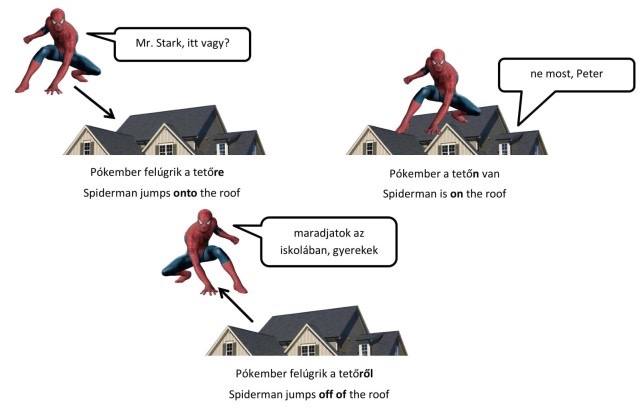
These three all go together as cases of movement involving surfaces. They function like the Illative/Inessive/Elative, but with surfaces instead of places.
Sublative (-ra/-re)
- back-vowel word: -ra
- front-vowel word: -re
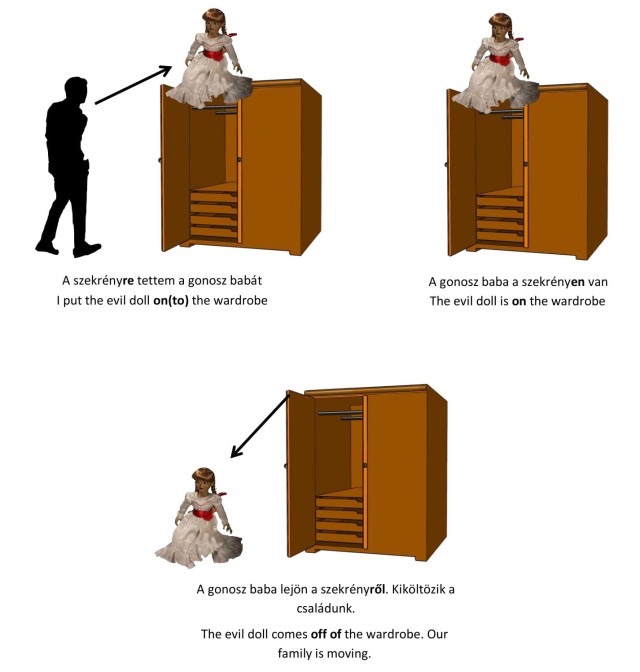
This, like -ba/-be, means that something is moving. The difference between -ra/-re and -ba/-be is that -ra/-re is talking about moving something ONTO something, instead of inside of. Where “a szekrénybe” means “into the wardrobe”, “a szekrényRE” means “onto the wardrobe”.
Use -ra/-re when:
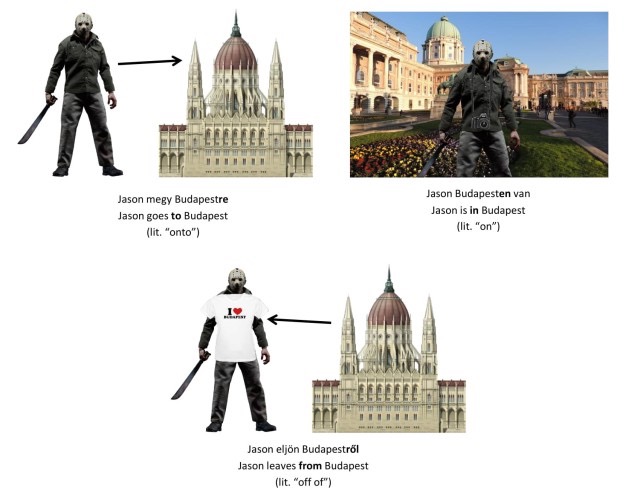
- you are on your way to a Hungarian city (other cities use -ba/-be, Hungarian cities use -ra/-re)
- you are moving something onto something
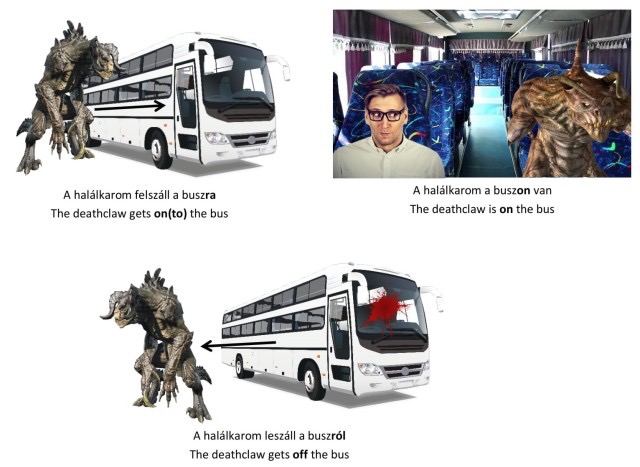
- you are getting onto most forms of public transport (bus/plane/metro/train, etc) – *for cars and minibuses you use -ba/-be
Examples
Megyek Budapestre → I am going to Budapest.
Felszállok a buszra → I am getting on(to) the bus.
A szekrényre tettem a játékot → I put the toy on(to) the wardrobe.
Az asztalra tettem a könyvet → I put the book on(to) the table.
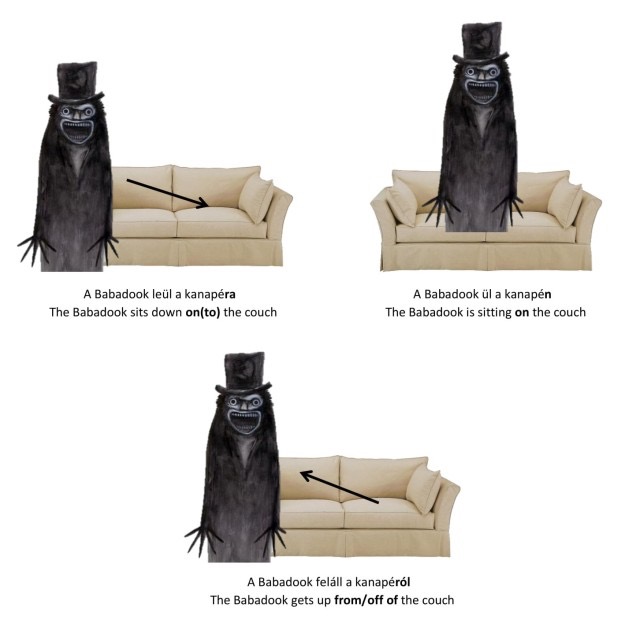
Leülök a kanapéra → I sit down on(to) the couch/sofa.
Leülök a székre → I sit down on(to) the chair.
Note that the object receiving the direct action (being put, placed, etc) will take the accusative.
Superessive (-n/-on/-en/-ön)
- ending in a vowel: -n (make sure to lengthen the vowel!)
- back-vowel word: -on
- front-vowel word: -en ; -ön (rounded)
This is essentially the static version of -ra/-re. Nothing is moving. Instead, something is currently on a surface. It functions the same as -ban/-ben, except we are talking about currently being on something instead of inside something. While “a szekrényben” means “inside the wardrobe”, “a szekrényEN” means “ON the wardrobe”.
Use -n/-on/-en/-ön when:
- you are currently IN a Hungarian city (other cities use -ban/-ben)
- something is currently ON TOP of something (a surface)
- you are currently in/on most forms of public transport (bus/plane/metro/train, etc) – *for cars and minibuses you use -ban/-ben
Examples
Budapesten vagyok → I am in Budapest.
Buszon vagyok → I am on the bus.
A játék a szekrényen van → The toy is on the wardrobe
A könyv az asztalon van → The book is on the table
Ülök a kanapén → I am (currently) sitting on the couch/sofa.
Ülök a széken → I am (currently) sitting on the chair.
Notice the difference? No one is moving or doing anything. -n/-on/-en/-ön merely indicates a current position of being on something (a surface, typically). Note that the direct object is now the subject in these sentences, and is thus in the nominative case, and not the accusative.
Delative (-ról/-ről)
- back-vowel word: -ról
- front-vowel word: -ről
Think of this as the reverse of -ra/-re. Instead of getting on or putting something on something, you are coming OFF OF something, or taking something OFF OF something.
Use -ról/-ről when:
- you are leaving a Hungarian city (other cities use -ból/-ből)
- you are taking something off of something (a surface)
- you are getting off of most forms of public transport (bus/plane/metro/train, etc) – *for cars and minibuses you use -ból/-ből
Examples
Budapestről jövök → I am coming out of/from Budapest.
Leszállok a buszról → I am getting off of the bus.
Leveszem a játékot a szekrényről → I take the toy off of the wardrobe.
Leveszem a könyvet az asztalról → I take the book off of the table.
Felállok a kanapéról → I get up from/off of the couch/sofa.
Felállok a székről → I get up from/off of the chair.
Notice that the subject with -n/-on/-en/-ön is now the direct object again, and thus in the accusative case, because something is being done to it once more.
Here are some visual illustrations:
![[Hungarian] Time Expressions with Postpositions – Better Hungarian Avatar](https://betterhungarian.com/wp-content/uploads/2019/02/cropped-1.jpg?w=40)
 Better Hungarian
Leave a reply to [Hungarian] Have to/Must/Need: Kell / Muszáj / Szükség – Better Hungarian Cancel reply